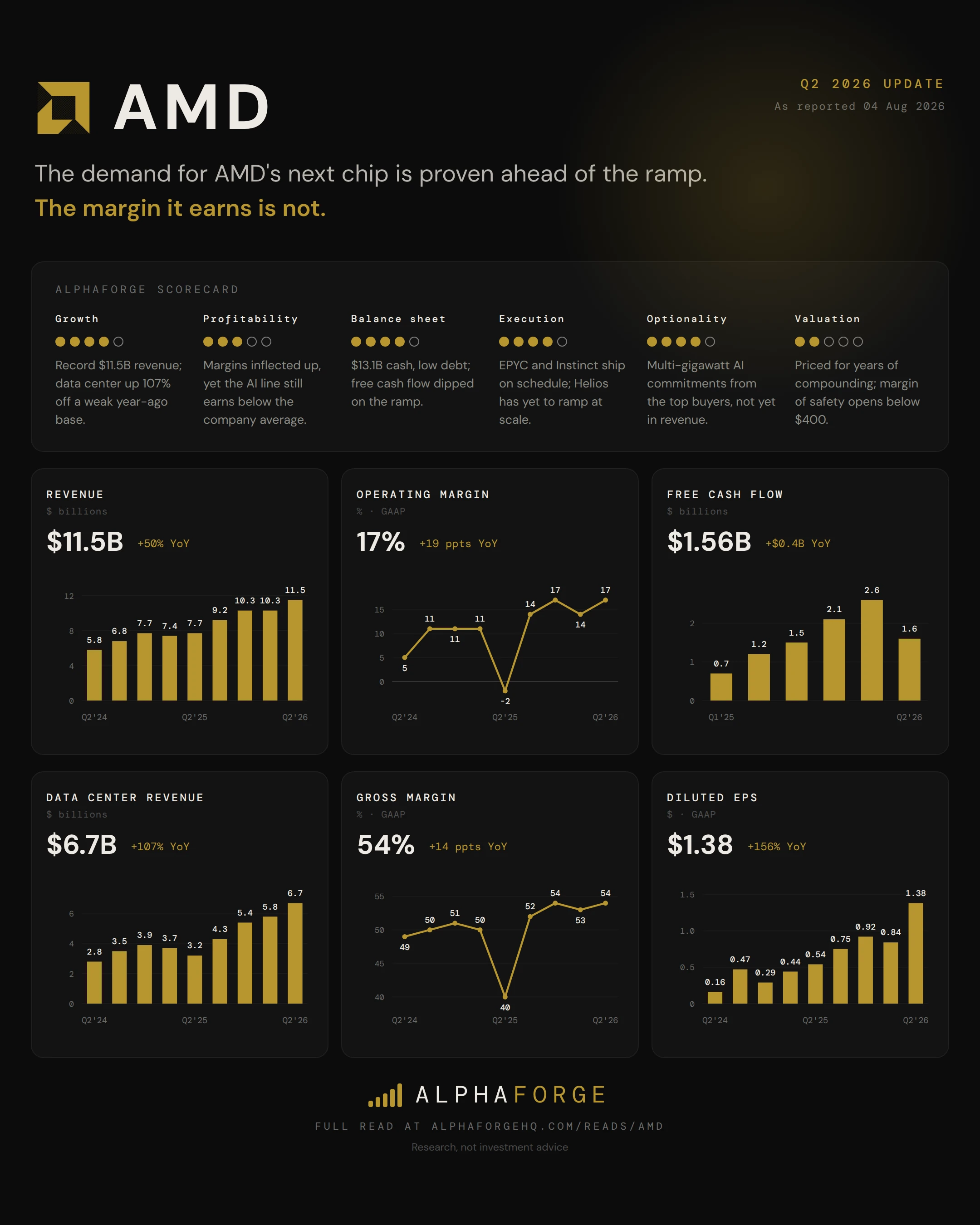
AMD posted a record quarter across revenue, operating income, and cash reserves. Revenue rose 50%, data center revenue more than doubled, and operating margin went from negative 2% a year ago to 17%.
The number that matters more is one AMD does not report: the gross margin on its data center AI accelerators, the product most of its valuation rests on. That margin sits below the company's own average, and management has guided it to stay there through the MI450 ramp into 2027. AMD's gross margin is a blend of every product line it sells. It slips when a line with a below-average margin grows into a bigger share of revenue, and that is what is happening here: no individual product's margin is structurally declining.
This Read assesses AMD across six axes, from growth to valuation, and sets the price at which the risk-reward turns in the investor's favour.
AMD reported record revenue of $11.54 billion, up 50% year-over-year and 13% quarter-over-quarter.
Data Center, now roughly 58% of revenue, generated $6.72 billion, up 107% year-over-year. The other two segments grew far more slowly: Client and Gaming rose 6% to $3.84 billion, and Embedded rose 19% to $977 million. The year-over-year gains lean on a weak year-ago base.
In the second quarter of 2025, AMD absorbed an $800 million charge tied to United States export controls on its Instinct MI308 accelerators, and Data Center operating income that quarter was negative. Against that depressed quarter, the segment's 107% year-over-year gain overstates the true rate of growth. The quarter-over-quarter comparison is the truer read: the segment grew 16%, strong by any measure but well below the headline 107% year-over-year.
AMD's Data Center segment consists of two lines. It blends EPYC server processors, the CPU side of the segment, with Instinct AI accelerators, the GPU side and the newer, faster-growing line. Both contributed to the segment's growth this quarter: AMD tied the segment's strength to strong EPYC demand alongside a continued Instinct ramp, and management said its data center AI revenue more than doubled year-over-year as MI350-series adoption broadened. AMD does not break the two out in dollar terms, so the precise split is not knowable from the filing, but the direction is clear enough: both lines are growing.
Outside Data Center, growth is more modest. Client and Gaming is one segment of two very different lines: Client, the PC processor business, grew on continued share gains and a richer mix of premium Ryzen parts, while gaming stayed soft, which held the combined segment to 6% year-over-year. Embedded, the former Xilinx franchise (the FPGA business AMD bought in 2022), grew 19% year-over-year, a third straight quarter of growth after six quarters of decline.
The key takeaway from the quarter: AMD is now growing fastest exactly where it is most valued, in the data center. But that fastest-growing segment is not its highest-margin one.
This quarter showed operating leverage: profit grew faster than revenue, reversing several years in which revenue grew faster than profit.
Profit outgrowing revenue means margins expanded, but by how much depends on which margin you look at. AMD's adjusted, or non-GAAP, operating margin was 27%, on a record $3.09 billion of operating income; under standard GAAP accounting rules, it was 17%. The roughly ten-point gap between the two is mostly stock-based compensation and the amortization of intangibles from past acquisitions, together about $1.05 billion.
Of the two margins, the GAAP 17% is the better one to judge AMD by, because both items the adjustment removes are real costs: stock-based compensation dilutes existing shareholders, and the amortization reflects money AMD spent to buy those businesses. The gap between the two is also narrowing, from 17 points two years ago to 10 now: the two items together grew only about 10%, rising stock-based compensation largely offset by falling amortization, while revenue nearly doubled, so the GAAP margin is improving faster than the adjusted one.
The year-over-year improvement in operating margin is also smaller than it looks. A year ago the GAAP operating margin was negative 2%, held down by the $800 million export-control charge; excluding that charge, it was about 9%. (The adjusted 12% on the chart still includes the charge.) So AMD is more profitable than a year ago, but the gain is roughly eight points, from about 9% to 17%, not the jump off a negative base the headline shows. Regardless, eight points of operating margin expansion in a single year is substantial.
Instinct, AMD's data center GPU line, is the fastest-growing part of the business, but its gross margin sits below the company average. Every extra dollar of Instinct revenue pulls the blended margin down, and management has guided the new MI450's gross margin to stay below the company average through its early ramp.
Despite that drag, the blended gross margin rose this quarter, from 55% to 56%. The reason is segment mix: revenue moved out of Client and Gaming, AMD's lowest-margin segment, and into Data Center. That shift more than offset the Instinct drag, which itself did not ease. AMD does not report gross margin by segment, so the table below compares operating margins instead.
| Segment | Share of revenue, Q1 → Q2 | Operating margin, Q2 |
|---|---|---|
| Data Center | 56.3% → 58.2% | 31% |
| Client and Gaming | 35.2% → 33.3% | 15% |
| Embedded | 8.5% → 8.5% | 40% |
What the table cannot show is Instinct itself. AMD reports it only inside Data Center, blended with its higher-margin EPYC server processors, so the segment's 31% flatters it. Instinct's own margin, the number both the growth story and the valuation depend on, sits one level below anything AMD discloses.
AMD guided third-quarter gross margin to roughly 56%, flat quarter-over-quarter, while guiding data-center revenue up by a strong double-digit percentage over the same period. Guiding the blended margin to hold flat while Instinct scales is itself a statement that Instinct earns below the blend: if that revenue came in above the average, scaling it would push the margin up, not hold it level.
The market acted on exactly this when AMD reported: a record quarter paired with the flat guide sent the stock down 8 to 9%, with coverage attributing the drop to the flat margin guidance, not the results. For an investor, that is the signal in itself: the market is treating this margin question as the main driver of the share price, so the share price is likely to stay volatile around each quarter's margin figures.
None of this is a margin decline. A below-average margin on revenue growing this fast still adds more gross-profit dollars than the dilution takes away, so total gross profit keeps climbing even as the rate holds flat.
The one thing that could interrupt that is spending. Non-GAAP operating expense reached $3.4 billion this quarter, up 40% year-over-year on AI research and development, and is guided to about $3.65 billion next quarter. Gross profit is still outgrowing it, which is why operating income set a record.
The question beneath all of it is why the AI line earns below average at all, and the answer is pricing power. Nvidia's company gross margin runs near 75%, on a business that is roughly 93% data-center AI hardware; AMD's whole company earns 56%, and its AI line sits below even that. AMD competes as the value alternative, on price and on total cost of ownership, the all-in cost of buying and running the hardware, not on a premium price it can command.
That is the bear case: AMD is the credible second source in AI accelerators, a distant second by share, not the price-maker. The bull case is that volume at this scale is its own kind of power, and that Instinct's gross margin converges toward the company average as the ramp matures and yields improve.
The quarter proves the demand: data center AI revenue more than doubled. The margin is still unproven: Instinct, the line driving the growth, has yet to show its margin climbing toward the company average as the ramp matures. Because AMD does not disclose Instinct's margin, investors will see it only indirectly, in the blended gross margin over the coming years. Whether AMD can keep funding the ramp until then is what the Balance Sheet section takes up next.
AMD can fund the ramp, and comfortably.
It ended the quarter with a record $13.1 billion in cash and short-term investments against just $3.2 billion of debt, roughly $9.9 billion in net cash. That covers years of the Instinct ramp and the multi-gigawatt deployments it has under contract with Meta, Anthropic and others without ever going to the capital markets. So the debt it raised weeks after the quarter closed was a choice, not a necessity.
Cash flow is where the Instinct ramp starts to show. Operating cash flow was a healthy $2.37 billion, but free cash flow, which is operating cash flow minus what AMD spends on plant and equipment, fell to $1.56 billion from the prior quarter's record $2.57 billion, or 14% of revenue, down from 25%. Two things drove the decline.
Capital expenditure more than doubled, from $389 million to $808 million, as AMD builds capacity ahead of the planned 2027 deployments. The other was working capital: receivables rose 21%, faster than revenue's 13%, and inventory edged up 5% to $8.5 billion. On the chart, the gap between the two lines narrowed from both sides, capital spending doubling while operating cash flow fell.
The capital spending is the clear ramp signal. The working capital is less clear: net income rose 66% quarter-over-quarter, so the cash decline did not come from earnings, but receivables outgrowing revenue is the line to recheck next quarter. One quarter of it fits a ramp; a second would raise a collection question.
In mid-August, three weeks after the quarter closed, AMD priced $4.75 billion of senior notes in four tranches maturing between 2029 and 2036, its largest bond sale ever, taking total debt from $3.2 billion to roughly $8 billion. At coupons of 4.6% to 5.5%, the roughly $240 million in annual interest is small against $13 billion of cash and a 21% operating cash-flow margin, and it locks in long-dated funding for the buildout at known rates. It marks a shift in posture: a company that has run essentially debt-free is now willing to borrow to build, ahead of the revenue that will justify it.
None of this puts solvency in question. Even after the raise, AMD holds more cash than debt. But a balance sheet this strong invites the assumption that there is no risk in it at all, and that is not quite right. The capital is going into a buildout whose return arrives in 2027 and beyond, funded partly now with borrowed money, and what that revenue is ultimately worth depends on Instinct's margin, which remains the open question. Whether AMD can turn that capital into rack-scale AI systems, shipped on the schedules it has set, is what the Execution section takes up next.
AMD enters the 2027 buildout with a strong record and one large unknown.
AMD has held its annual accelerator cadence, MI300 in 2023 and MI350 at volume today, with MI450 next, and this quarter it posted a fifth straight quarter of record server CPU revenue, with cloud and enterprise sales each up more than 70% year-over-year and AMD gaining server revenue share again. On chips, AMD's delivery record is among the best in the industry.
| Commitment | Timeline | Status |
|---|---|---|
| Instinct MI300 | 2023 | Shipped on cadence |
| Instinct MI350 series | Current generation | At volume; drove data-center AI revenue to more than double YoY |
| Instinct MI450 series | Next generation | On the annual cadence; ramps 2026-27 |
| EPYC server CPUs | Ongoing | Fifth straight record quarter; cloud and enterprise each +70% YoY; gaining server share |
| Revenue vs. guidance | Guided each quarter | Beat the guide five quarters running, usually by more than the full range |
| Helios rack (MI450 + Venice + Pensando) | First shipments 2H 2026, ramp through 2027 | Not yet shipped; AMD's first rack-scale system and the main execution risk |
The same record shows up in AMD's own guidance. For five straight quarters it has set a revenue target and come in above it, the actual line riding above the guided line in the chart below, usually by more than the entire guidance range. The bar it has set for the third quarter is about $13 billion.
The unknown is the rack. AMD has always sold the chips that go into other people's racks. Helios is the first time it sells the whole rack itself, and that is where the execution risk sits. Helios is a single liquid-cooled system of 72 MI450 GPUs, Venice CPUs and Pensando networking, integrated and validated as one unit, and AMD has never shipped anything like it at volume.
The distance between shipping a chip and shipping a rack is wider than it sounds, and the 2027 numbers depend on AMD closing it. A chip is one component that a system builder or a hyperscaler drops into a design it already owns. A rack moves that integration onto AMD's own side of the line: the 72 GPUs, their CPUs, the networking fabric between them, the power delivery, the liquid cooling, and the software that makes the assembly usable, all of it AMD's to get right at once. It ships when every layer works together, and the failure of any single layer holds up the unit. That is why the first Helios racks will be the hardest to build and the least profitable. When a system this complex first enters production, a high share of what comes off the line is faulty and has to be scrapped or reworked, so the racks that do ship early carry the cost of the ones that did not. Only as AMD works those problems out, across the first few quarters, does more of each batch ship clean and the margin recover. There is little slack in the schedule. First shipments are targeted for the second half of 2026 and the ramp runs through 2027, and the 2027 growth AMD is guiding to, data-center revenue more than doubling again, assumes Helios arrives close to on time.
One thing lowers the usual risk of a first-generation product. AMD's biggest customers are helping build it, not just waiting to buy it. Meta co-defined the open rack standard Helios uses. The largest AI labs are contributing to AMD's GPU software, long its weakest point against Nvidia and the closest thing Nvidia has to a moat. The top customers are getting Instinct silicon tuned to their own workloads. Hardware shaped by the companies that will run it, with billions already committed against it, is far less likely to fall short of the workloads it was built for, the failure that usually meets a challenger's first attempt.
So the verdict splits cleanly. On chips, AMD has earned trust, and earned it again this quarter. On racks, it has not yet, because the one product the 2027 numbers depend on has not shipped. A record this consistent makes it likely AMD ships Helios close to schedule, and customers helping build the rack make it unlikely to fall short of their requirements once it does. But the growth AMD is priced for runs straight through this one unproven product. What that growth is worth, once the stock and cash AMD spent to lock it in are netted out, is what Optionality takes up next.
For most companies, optionality is speculative: a product still on the roadmap, a market still theoretical, a payoff the company hopes to earn. AMD's largest bets have already been underwritten by the buyers themselves. The demand is not a forecast; it is a book of contracts signed by the companies with the deepest AI budgets in the world. What is uncertain is not the demand, but whether AMD can deliver against it on time and at an acceptable margin.
| Buyer | Commitment | When it lands | Cost to AMD holders |
|---|---|---|---|
| OpenAI | Up to 6 GW of Instinct GPUs | Milestone-based | Warrant for up to ~160M shares (~10%) |
| Meta | Up to 6 GW | Five-year supply agreement | Warrant for up to ~160M shares (~10%) |
| Anthropic | Up to 2 GW | From 2027 | AMD investing up to $5B into Anthropic |
| Oracle | 50,000 MI450 GPUs | Starting Q3 2026 | None disclosed |
| Microsoft | Helios deployed on Azure | Not specified | None disclosed |
The commitments are multi-year and multi-gigawatt, and they come from a concentrated set of buyers. That concentration cuts both ways. It anchors the backlog in named contracts rather than a diffuse market estimate, but it also ties AMD's next two years to the continued spending of a few customers, and a slowdown at any one of them would be felt directly.
These contracts also reach past MI450. OpenAI's agreement covers multiple Instinct generations and Meta's covers several, so a Helios ramp that lands is not a single 2027 revenue event. Each later generation ships into demand that is already contracted and partly designed with the buyers themselves.
AMD expects the business to grow well beyond the signed contracts. At its July Advancing AI event it raised its estimate for the data-center AI accelerator market to roughly $1.4 trillion by 2030, and for server CPUs to roughly $220 billion. Its long-range model, set at the November 2025 analyst day, calls for non-GAAP EPS above $20 within three to five years, close to five times the $4.17 it earned on the same basis in 2025, and management now expects to exceed it. The signed contracts are what separate these targets from a market forecast.
That upside comes at a cost to existing holders. OpenAI and Meta were each granted warrants to buy up to roughly 160 million AMD shares at a nominal price, close to 10% of the company apiece, vesting in tranches as each customer reaches its deployment milestones and AMD's share price clears set thresholds. If both vest in full, dilution approaches 20%. AMD has also committed to invest up to $5 billion in Anthropic, one of its own buyers. These terms did not create the demand, since no customer commits gigawatts to hardware it does not trust, but they are what AMD gave up to secure commitments of this size and length as the second supplier. Because the warrants vest only as the deployments happen, the dilution arrives alongside the growth that pays for it: holders end up owning a smaller share of a larger AMD.
The optionality, then, is concrete: contracted, named and years deep. It is also concentrated in a few buyers, partly paid for in stock and cash, and dependent on a ramp that has not happened yet. Whether it is worth owning depends on the price paid for it, which is what Valuation takes up next.
At the price above, AMD carries a market capitalization near $1.03 trillion, close to its 52-week high. Measured against the earnings it actually reports, the stock is extraordinarily expensive: roughly 160 times trailing twelve-month GAAP earnings of $3.89 a share.
Measured against the earnings management has guided to, the multiple is far lower. On 2027 consensus estimates the multiple falls to about 40 times, and against AMD's long-range model, non-GAAP EPS above $20, it drops toward 32 times.
Put the other way, the price already assumes a largely successful Helios rack ramp. Trailing earnings do not support $1 trillion; only the guided ramp does. That guide is management's own: data-center revenue more than doubling in 2027, with the margin on it no worse than guided. The market is not inventing a scenario; it is taking AMD at its word.
The bet is not on whether the target is reasonable, but on whether AMD executes a rack-scale product it has never shipped at volume, close to the schedule it has promised. At the publication price, the valuation leaves little room for that ramp to arrive late, or at a lower margin than guided.
The Street is overwhelmingly bullish.
| Firm | Target | Rating |
|---|---|---|
| Morgan Stanley | $465 | Equal Weight |
| BMO Capital | $550 | Outperform |
| Wedbush | $600 | Outperform |
| Goldman Sachs | $640 | Buy |
| Bank of America | $720 | Buy |
| UBS | $730 | Buy |
| Baird | $1,250 | Outperform |
The consensus rating remains a buy, but the price has caught up with the targets. Morgan Stanley at $465 on an equal-weight rating, BMO at $550 and Wedbush at $600 sit below the publication price, and Goldman's $640 sits just above it. Only Bank of America at $720, raised in late September, UBS at $730 and Baird's Street-high $1,250 still leave clear room. Ratings that stay bullish after the price has passed several of their own targets say little about the price itself; that judgment falls to the investor.
AlphaForge's read is that the business quality justifies ownership and the price justifies patience. At the $630.63 publication price, AMD trades at about 32 times the $20 floor of its own long-range EPS model, a floor that only holds if the ramp succeeds. Below $485, that multiple falls to about 24 times. At that level, the price no longer depends on the ramp going to plan: it leaves room for Helios to arrive late or at a lower margin than guided. That is why AlphaForge sets the entry zone below $485.
I am long-term bullish on AMD, and I am disciplined about the price I pay for it.
The case for owning AMD rests on contracted demand. OpenAI, Meta, Anthropic and Oracle have committed in writing, multi-year and multi-gigawatt, and Microsoft will run Helios on Azure; even net of the warrants AMD granted to secure some of it, that is a book of demand few companies have.
Behind it sits a business already performing: record revenue of $11.5 billion, up 50% year-over-year, data center revenue more than doubling year-over-year, GAAP operating margin about eight points higher than a year ago on an underlying basis, and $13 billion in cash against little debt.
Two risks stand against that case. The first is margin: AMD's AI line earns below the company average, and the market marks the stock down each time that question resurfaces. In my view this dilutes only the margin rate, not gross profit: a below-average margin on revenue growing more than 100% year-over-year still adds more gross profit than the mix takes away, and operating margin is already climbing on that math. I expect the market's concern about the blended margin to ease as the Instinct ramp matures and its margin moves toward the company average.
The second is Helios, the rack AMD has never shipped at volume and the one test it has not yet passed. Here AMD's customers lower the risk: OpenAI, Meta and the other labs are helping build the rack, not just ordering it, which makes it far less likely to fall short of the workloads it was built for.
Neither of those answers makes the stock cheap. At the $630.63 publication price, the valuation already assumes the ramp succeeds, so how much I buy depends on the price.
Above $485, I buy AMD in small, regular amounts, averaging in rather than chasing it. Below $485, I put to work the cash I have kept on the sidelines, in amounts many times larger than those regular purchases.
Sources · AMD Q2 2026 Deck · AMD Q1 2026 Deck · AMD Q4 2025 Deck · AMD Q3 2025 Deck · AMD Q2 2025 Deck · AMD Q1 2025 Deck · AMD Q4 2024 Deck · AMD Q3 2024 Deck · AMD Q2 2024 Deck · AMD Q1 2024 Deck · AMD Q1 2026 Earnings Call · AMD Q2 2026 Earnings Call · AMD Advancing AI 2026
Get an email when a new Read goes live, something material changes, or a video lands. No spam, no fixed schedule.
- ✓A new Read when it publishes
- ✓A short Note when something material changes between quarters
- ✓The occasional video worth your time