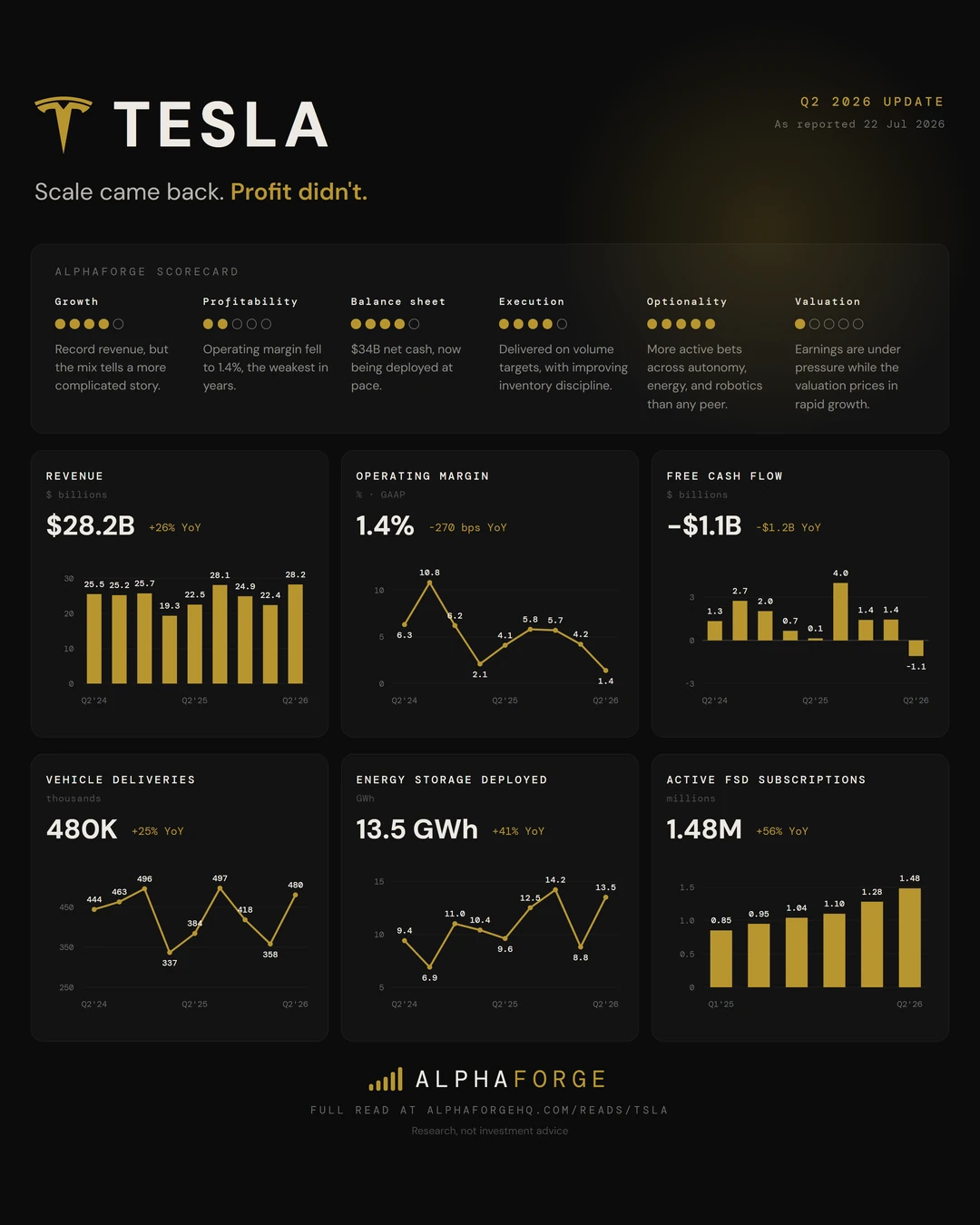
Tesla posted its strongest revenue quarter in history and one of its weakest operating margins in years, both in the same quarter. Revenue climbed 26% to $28.24 billion on record Q2 deliveries. Operating income, however, collapsed 57% to $398 million.
The underlying business remains intact: a record Q2 for deliveries, roughly $34 billion in net cash, and an expanding set of options in autonomy, energy storage, and robotics. What no longer holds is the assumption that scale, on its own, reliably converts into profit. Instead, Tesla is choosing to spend everything it earns, and more, to fund the next chapter, and asking investors to value it on that future rather than the present. That bet may pay off in the end, but this quarter does not yet prove it will.
The rest of this Read works through that claim one axis at a time, and asks what price, if any, makes the bet worth taking.
Tesla's strongest revenue quarter on record came in at $28.24 billion, and carried a milestone with it: on a trailing-twelve-month basis, revenue crossed $100 billion for the first time. On paper it reads as an unambiguous win. Look beneath the headline, though, and the composition of that growth points to a company in transition. The automotive business generated $20.52 billion, up 23%, still below the $21.56 billion it earned in Q4 2023 on almost exactly the same number of deliveries. The new company-wide high was instead powered by the two smaller segments: Services & Other surged 50% to $4.58 billion, while Energy Generation and Storage rose 13% to $3.14 billion on its second-largest quarter of deployments.
Tesla's ability to sell in volume is not in question. The company delivered a Q2-record 480,126 vehicles, up 25%, with Model 3 and Model Y accounting for 467,762 units. Automotive revenue, however, grew more slowly than deliveries (23% versus 25%), so revenue per vehicle slipped to roughly $42,700. Energy showed the same pattern more sharply: deployments rose 40% to 13.5 GWh from 9.6 GWh a year earlier, yet revenue grew just 13%. Tesla is scaling as impressively as ever, yet more units no longer translate automatically into more revenue.
That is a common enough dynamic during rapid scaling, but it matters more for Tesla. For years the company enjoyed something rare: the ability to raise prices while demand still outstripped supply, driving industry-leading automotive margins. As that pricing power fades, the burden shifts to operational execution, cost discipline, and capital efficiency, the disciplines of a high-volume manufacturer rather than an innovation-led premium player. Tesla starts from a position of strength here, with deep vertical integration, in-house batteries, software, and chips, plus a long-standing manufacturing cost advantage that leaves it better equipped than most rivals.
The pattern is consistent across both automotive and energy: Tesla's growth is becoming volume-driven rather than price-driven. That was enough to deliver a record revenue quarter, but it also marks a shift in how the company creates and captures value. Whether that shift has begun to compress underlying margins is the question the Profitability section takes up.
A note on scope: this section looks only at the parts of Tesla that already operate at scale, its cars, its energy business, and its services arm. The younger and less established bets, full self-driving and Robotaxi, the Cybercab, and Optimus, contribute almost nothing to these numbers today. Their potential is addressed separately under Optionality.
On the headline numbers, Tesla's profitability is in decline. Beneath them, however, the underlying businesses remain intact. Automotive earned a 16.9% gross margin, Energy 20.4%, and Services a record 14.1%. None is exceptional, and Energy's margin was pulled down sharply by a supplier warranty charge, but a company generating $4.75 billion of gross profit on $28.24 billion of revenue is not a company with a product problem.
The more important question is what happens to that gross profit next. Operating expenses consumed $4.35 billion of the $4.75 billion, or 92% of gross profit. Half of that spending was research and development, which reached a record $2.37 billion, up 49% year-over-year. Tesla attributes the increase to AI and other R&D projects, alongside stock compensation related to the 2025 CEO award.
That left just $398 million of operating income, equivalent to a 1.4% operating margin and the thinnest Tesla has reported since the Model 3 ramp. A thin operating margin is not automatically bad news; it is what a company looks like when it is spending its gross profit rather than banking it. Whether that spending ultimately earns an adequate return is a separate question, and one the Optionality section takes up.
The chart below sets the two margins against each other. Gross margin came in at 16.8% of revenue, little changed from the 17.2% of a year ago but well below the 21.1% of last quarter. That sequential fall traces to one fact: revenue rose 26% from the prior quarter while gross profit in dollars barely moved, so a nearly unchanged profit spread across a much larger base and the rate fell. Operating margin, the lower line, sits at 1.4%, below the 4% to 6% band Tesla held through the past year, as operating profit fell 57% to $398 million.
The distance between those two lines, from 16.8% gross to 1.4% operating, is a spending story rather than a sales one. Operating expenses grew $1.40 billion year over year against $873 million more gross profit, and that gap is the whole of the fall in operating profit. It was a deliberate choice, not a market failure: most of the increase is research and development, the rest largely administrative costs on the 2025 CEO stock award.
The gross profit held flat in dollars because the three segments moved in different directions. Automotive, about 73% of revenue, was little changed at a 16.9% margin. That figure still carries the regulatory credits Tesla sells to other carmakers, a near-cost-free stream that fell 67% to $146 million and is expected to fade toward zero by 2027, as a 2025 US law removes the reason others have to buy it. Strip those credits out and the underlying car margin is rising rather than flat. That is the more telling trend: Tesla is earning more from the cars themselves as the credit income fades.
Energy, usually the highest-margin segment, was the weak point: its margin fell from 30.3% a year ago to 20.4%, dragged down by a warranty charge tied to faulty cells from an outside supplier. The move looks severe, but Energy is only about a tenth of revenue, so even a full recovery to its usual margin near 30% would lift the total gross margin by only about a point, to roughly 17.9%. The charge weighed on the segment, but it is not what pulled the company's gross margin down.
Services, the smallest segment, was the standout. Its margin more than doubled from 5.4% a year ago to a record 14.1%, as a larger installed base of vehicles on the road generated more service revenue. That improvement was the main offset to the Energy drop, and it is what held the blended gross margin roughly flat against a year ago.
The 57% fall in operating profit did not carry through to the bottom line. Net income under GAAP was $1.11 billion, down only 5% from a year ago, because two items that did not exist a year earlier did most of the work holding it up: a $763 million after-tax gain on Tesla's SpaceX stake, which went public in June and which Tesla booked without selling a share, and a $274 million one-time tax benefit. Neither came from selling cars, energy, or services, and on Tesla's own adjusted measure, which strips both out, profit fell 17% rather than 5%. The SpaceX gain is already worth less than the quarter implies, with the shares now below their June IPO price.
How thin the operating result really was shows up against Tesla's own balance sheet. Interest on the $43.5 billion of cash and investments came to $422 million this quarter, more than the $398 million earned by all of its businesses combined.
The question the quarter leaves open is whether the margin compression is temporary or structural: the passing cost of a deliberate build-out, or the first sign of a permanently lower-margin Tesla. It points both ways. On the spending, the squeeze looks self-inflicted: had it grown only in line with gross profit, operating margin would have held near the 4% of a year ago, and beneath the headline the underlying car margin and record Services profitability are both improving. On the product, it looks harder to undo: automotive is still the large majority of revenue and now runs on meaningfully thinner margins than at its peak, with the credit cushion going away and pricing power softening.
Which way it resolves is not for this section to decide. It rests on two questions answered elsewhere: whether the AI and autonomy spending earns its return, which the Optionality section takes up, and whether Tesla can fund years of negative free cash flow while it finds out, which the Balance Sheet section takes up next.
The Profitability section closed on a question of endurance: whether Tesla can fund years of heavy investment while its operating profit thins. The balance sheet is where that question gets answered.
Tesla holds $43.5 billion in cash and short-term investments against just $9.3 billion of debt and finance leases, leaving roughly $34.2 billion in net cash and no meaningful leverage. Stockholders' equity stands at $86.9 billion, and total assets have grown to $148.5 billion. This is not a company that has to raise money to do what it has planned. It could absorb years of free cash flow deficits out of cash on hand without ever going to the capital markets.
What changed this quarter is the cash trajectory. For two years the cash pile grew steadily, quarter after quarter, because the business generated more than it spent. This quarter that reversed. Capital expenditure more than doubled year-over-year to $5.79 billion, up 142%, and rose $3.3 billion in a single quarter. Operating cash flow of $4.7 billion, roughly 17% of revenue, was not enough to cover it. Free cash flow came in at negative $1.09 billion, the first negative quarter since early 2024, and the cash balance fell $1.2 billion, to $43.5 billion.
After two years of building the cushion, Tesla has now started spending it.
The new spending is not maintenance. It is going into battery capacity, the Megafactory in Texas, the first Optimus production lines at Fremont, and the AI compute behind the autonomy effort, which more than doubled in the first half of the year. Tesla calls this the largest investment period in its history, and for the first time the description and the cash statement agree.
None of this is a surprise. It is exactly what management guided toward: capital expenditure above $25 billion for 2026, the largest commitment the company has ever made, and free cash flow expected to stay negative across the year as the ramp takes hold. What makes this quarter notable is not the guidance, which was already on record, but the follow-through. For two years the pattern ran the other way, guidance pitched high and actual spending landing low. Capex came in near $8.5 billion for all of 2025, and the first quarter of 2026 spent just $2.5 billion. At no point in the prior two years did quarterly capex clear $3.5 billion. This quarter it reached $5.79 billion.
The negative free cash flow is not the balance sheet weakening; it is the transition Tesla has described for years finally showing up as spend.
None of this makes Tesla risk-free. A balance sheet this strong invites the assumption that there is no risk anywhere in it, and at the level of solvency that is true. But a company funding a build-out of this size out of a profit line that is thinning at the same time has less room for error than the $34 billion net-cash figure makes it look. The cushion is substantial, it is now being spent, and the return on the investment it is funding will not show up for years.
The balance sheet tells you Tesla can afford the build-out. But affording it and executing it are separate questions: what a war chest this size really buys is time, and time is only worth something if the company delivers on what it has committed to build. Whether Tesla is shipping what it said it would, on the timelines it set, is what the Execution section takes up next.
The Balance Sheet section settled affordability. The question it leaves open is the plainest in the Read: whether Tesla ships what it commits to, on the timelines it sets. Execution is where that gets answered.
Three months ago, the Q1 Outlook laid out the near-term schedule: Cybercab, the Semi, and Megapack 3 all due to enter production in 2026. This quarter, each advanced on schedule. Cybercab entered production at Gigafactory Texas. The Model YL launched in the US in July. Megafactory Texas is nearing completion, Semi remains on track in Nevada, and the first Optimus lines are being installed at Fremont after the Model S and X lines were decommissioned. Inventory improved, too: days of supply fell from 27 to 15, reversing the Q1 build-up, as deliveries of 480,126, a Q2 record, ran ahead of production of 451,758.
None of this is new. At building physical things at scale, Tesla's record is among the best in the industry. The Model 3 ramp came together when much of Wall Street was betting on a manufacturing failure. The Supercharger network grew into the largest of its kind. Energy storage went from a side project to a multi-billion-dollar business. Cumulative deliveries crossed 9.7 million vehicles this quarter. When Tesla commits to building a factory, a line, or a lower cost per car, it tends to arrive.
The problem has never been whether Tesla builds what it promises. It is when.
A million robotaxis "next year" was a promise Tesla made in 2020. Full self-driving has been about a year away for most of a decade. The Austin robotaxi launch, the Cybertruck, supervised FSD: each shipped, and each shipped years after the date first attached to it. The one thing that has not shipped at all is the endpoint the valuation leans on hardest: unsupervised autonomy at scale, promised since 2020 and still not delivered.
| Commitment | Promised | What happened |
|---|---|---|
| Model 3 mass production | 2017 | Roughly a year late; the ramp succeeded |
| Cybertruck | 2021 | Delivered late 2023 |
| FSD, unsupervised | "next year," repeatedly | Still supervised in 2026 |
| Robotaxi at scale | 1M robotaxis by 2020 | Pilot live 2025; scale still ahead |
| Optimus production line | Late July / Aug 2026 | Installing in Q2; "soon," not yet running |
| 2026 capex ramp | Guided above $25B | Underspent through Q1; ramped in Q2 |
For most companies a slipped timeline is a disappointment you absorb. For Tesla it is close to the central valuation risk, because so much of what the stock is priced on does not exist yet. A business worth, say, $100 billion in 2028 is worth about $80 billion once discounted to today; push the same business out to 2031 and it is worth closer to $57 billion. Close to 30% of the value disappears from timing alone, before any adjustment for the greater chance that a longer wait ends in failure. Delay does not subtract from Tesla's value in a straight line. It compresses it, and the longer the delay, the deeper the compression.
This quarter did close one long-standing credibility gap. For years Tesla guided capital spending high and then spent low; this quarter the spending finally caught up to the guidance, as the Balance Sheet section describes. Tesla is now funding the build-out it keeps describing, not just describing it. But funding is not shipping. The Optimus line at Fremont is still being installed, and Tesla's own timeline puts its production later in 2026.
So the honest verdict is split, and the split is the useful part. On everything close to the factory floor, building, ramping, cutting cost, and delivering, Tesla is an exceptional operator, and this quarter proved it again. On the timelines that matter most to the valuation, robotaxi at scale and Optimus in production, its own history suggests the dates will slip, probably by years. The next section, Optionality, puts a number on those future bets. Those numbers assume the bets arrive on time, and Tesla's record points the other way. The math above already showed the cost: a milestone that lands three years late is worth close to 30% less today. That is the discount to carry into the next section.
Most of Tesla's market value rests on what the company has yet to build, not on what it already runs. The car business, the energy business, the services line: together they are the part of Tesla you can already measure, and therefore value. Everything above that is a claim on what Tesla intends to become.
Tesla is a portfolio of large, speculative bets, each of which earns close to nothing today and any one of which, if it succeeds, could dwarf the value of the business Tesla has built so far. Robotaxi, Optimus, full self-driving at global scale, the autonomy stack underneath them: these are call options on the future, and the market is paying a premium on all of them now, up front, for payoffs that remain uncertain and years away.
The good news is that every one of those options moved closer to the money this quarter, and none stalled.
| Bet | Q2 2026 progress | Earning today | When it could matter |
|---|---|---|---|
| FSD & software | 1.48M subscriptions, +56% YoY; on 55%+ of new NA cars | Yes, and scaling | Now |
| Robotaxi | 7 US metros; unsupervised in Miami, Orlando, Tampa; Cybercab in production | Negligible | ~2027+ at scale |
| Optimus | First lines being installed at Fremont, not yet operational | No | ~2030+ at scale |
| Vertical integration & AI | Lithium/cathode (TX), LFP (NV), Austin fab, AI compute over 200MW | No (enabler) | Underpins all the above |
The most advanced of these bets is Tesla's full-self-driving software. Subscriptions reached 1.48 million, up 56% year-over-year, and more than 55% of new North American cars are now delivered with an FSD subscription attached. This is the single most important fact about Tesla today, because it is the one bet that has started to behave like a real business: recurring, high-margin revenue drawn from cars already on the road, growing as the fleet expands and more owners subscribe. Regulatory approvals added across Lithuania, Estonia, Denmark and Belgium widen the market it can grow into, and each one is a national regulator judging the software ready for supervised use on public roads.
Two bets sit further out, and the highest valuations rest almost entirely on them. Robotaxi now runs in seven US metros, with unsupervised rides launched in Miami, Orlando and Tampa, and Cybercab, the vehicle purpose-built for that fleet, entered production this quarter. Optimus is at an earlier stage: the first production lines are being installed at Fremont, with Tesla aiming to begin production in 2026. Neither earns much today, but both are where the largest numbers in the bull case live.
Underneath the customer-facing bets is something most carmakers would not attempt: Tesla is building the supply chain for all of it in-house. Lithium refining and cathode production in Texas, LFP cells in Nevada, a semiconductor fab in Austin, and AI training compute that more than doubled in the first half to over 200 megawatts across the Cortex 1 and 2 clusters. None of this is a product. It is the machine meant to make the products cheaper and faster than anyone else can, and it is the least visible part of the optionality precisely because it never shows up as a line item.
Add these together and you have the reason Tesla cannot be valued like a car company, and the reason professionals cannot agree on what it is worth at all. The table below captures it: firms covering the same company and the same quarter, with twelve-month targets that run from roughly $130 to $600. On the reported numbers they broadly agree. What they disagree on is which business Tesla becomes, and how soon.
| Firm | Target | Rating |
|---|---|---|
| Wells Fargo | $130 | Underweight |
| GLJ Research | $200 | Sell |
| DBS | $330 | Hold |
| Barclays | $370 | Equal Weight |
| Morgan Stanley | $400 | Equal Weight |
| Deutsche Bank | $420 | Hold |
| Wedbush | $600 | Outperform |
That spread is not analysts being sloppy. It is the honest width of Tesla's possible future outcomes. At the low end, you are looking at a slowing automaker whose options mostly fail. At the high end, you are looking at an autonomy and robotics platform that mostly works. The same set of facts supports both scenarios. At $313, the stock sits in the lower half of that range, nearer the automaker than the platform: the market is paying for the business it can see and treating the rest as a maybe.
Each of these bets is worth the figure the bull case puts on it only if it arrives, and roughly on time. Tesla's record says the big ones arrive late, and the Execution section already showed what a multi-year slip does to their present value. Both things are true at once: the optionality is exceptional, arguably greater than any other company in the market carries, and it has to be discounted hard against a record of missing its most ambitious dates by years.
What Optionality settles is narrow: the bets are large enough to price the stock on, and this quarter each of them advanced. What it cannot settle is whether any of them ultimately succeeds, or whether the price already asks so much that no margin of safety remains. That is the question the whole Read has been building toward, and Valuation takes it up: at $313, how much of that optionality are you paying for up front, and is any price low enough to make the risk worth taking.
Optionality showed the potential payoff is large and, this quarter, advancing; it could not say whether the current price already reflects too much of it. That is Valuation's question: at what price does the risk and reward come out in the buyer's favour? The price targets in the last section ranged from $130 to $600, and a spread that wide is not a valuation; it is proof that no one can price this company with confidence. So instead of adding another guess at Tesla's fair value, AlphaForge sets the price at which the odds tilt far enough toward the buyer to act.
At $313, on trailing twelve-month GAAP earnings of $1.08 a share, the price has little to do with what Tesla currently earns. Strip the price back to what the vehicles, energy and services could reasonably be worth on their earnings, and most of the market value is left unexplained. That remainder is the price of the optionality: the robotaxi, autonomy and Optimus bets that earn nothing yet, and that only pay off if they arrive, roughly on time.
The little that does rest on profit is thinning. The chart's two tallest bars, $12.6 billion and $12.9 billion, both still carry a one-time $5.93 billion release of a deferred tax valuation allowance from late 2023, an accounting gain rather than profit Tesla earned. The comparable peak, once that release drops out, is the $7.1 billion at the end of 2024, from which trailing net income has fallen 46%, to $3.8 billion. So the sliver of the valuation that rests on profit rests on a shrinking base.
So what AlphaForge publishes is a buy zone, not a forecast: an entry zone under $300. It is not a fair-value estimate; it is a threshold. Below it, you pay a defensible multiple for the business Tesla has already proven and get the optionality with enough margin of safety that no single bet has to arrive on time for the position to work. Above it, you are pre-paying for execution, buying the bets in advance at prices that assume Tesla meets deadlines its own record says it will likely miss.
At $313, Tesla stock trades about 4% above that zone. The premium is small, but it still puts the price above the zone rather than inside it: you are buying slightly early rather than with a margin of safety, and paying precisely for the timeline Tesla is least reliable on. At today's price, the risk and reward do not favour the buyer.
At $313, the stock does not offer a compelling entry.
AlphaForge rates Tesla NEUTRAL for existing shareholders; for new capital, a price below $300 begins to offer a meaningfully better risk-reward. A higher entry price, for any given set of future cash flows, produces a lower return, so for a thesis that is multi-year by definition, the entry price is the single biggest factor a buyer actually controls. The $300 level is anchored to Tesla's own trading history, not to a valuation output.
Over the past two years the stock has swung from the low $200s to the mid $400s and back, without any change in the underlying thesis. Against that record, a move of a few percent below $300 is not an exceptional distance; it is the kind of swing Tesla delivers in most years. The level is not a prediction that the stock will get there. It is a statement of where the risk-reward shifts meaningfully in favour of new capital.
The stock trades near 290 times trailing earnings, against roughly 25 times for the market as a whole. Even at $300 that multiple would still sit near 280 times. The entry zone improves the future return; it does not make Tesla cheap on today's numbers.
Tesla is one of the most compelling long-term holds in the market. Just not at $313.
I am not adding here. I am waiting for a pullback below $300, and I would accumulate from there. Long-term bullish on the company; disciplined on the entry.
Sources · Tesla Q2 2026 Deck · Tesla Q1 2026 Deck · Tesla Q4 2025 Deck · Tesla Q3 2025 Deck · Tesla Q2 2025 Deck · Tesla Q1 2025 Deck · Tesla Q4 2024 Deck · Tesla Q3 2024 Deck · Tesla Q2 2024 Deck · Tesla Q1 2024 Deck
Get an email when a new Read goes live, something material changes, or a video lands. No spam, no fixed schedule.
- ✓A new Read when it publishes
- ✓A short Note when something material changes between quarters
- ✓The occasional video worth your time